Cripta de la Colonia Güell

This church is part of an ambitious industrial complex, in the town of Santa Coloma de Cervello (Barcelona). A large textile factory that Eusebi Güell, the great patron of Gaudí, launched in 1890. Mr. Güell´s goal with Colonia Güell was he wanted to be away from the city, where trade union movement was growing and build workers’ houses beside the factory and integrate them into the same property, resulting in a village with its own personality that join social and economic life. As a distinctive feature of this colony, Güell wanted to give it cultural and sports facilities and, although initially not regarding building a church, a small existing chapel was used. When this chapel became too small for the growing population of the colony, Güell decided to instruct Gaudí to build a new church that could accommodate all the inhabitants. However, little did Güell imagine that Gaudí would make a proposal as sober, stern and radical. The architecture was based on the task of making Güell a place of worship, that harmonized with the unconventional architecture of the workers homes in Güell´s Colony, and with the nearby forest and the slope of the hill where it would be projected.

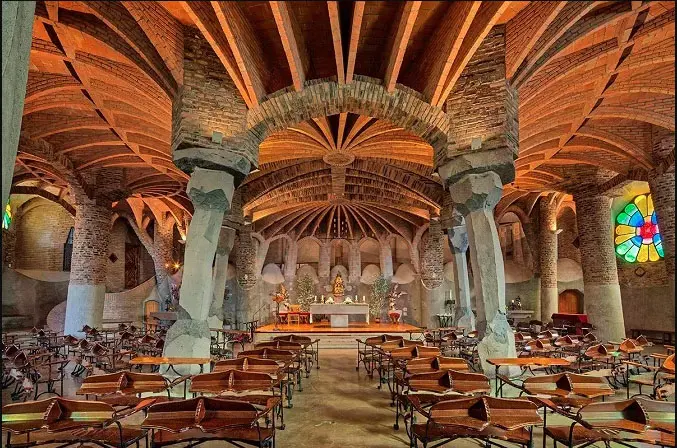
Although it is commonly called “Crypt Güell” actually there is none of the church that goes underground, since all the windows are facing the street. It is therefore the lower nave of the church, which remained unfinished, as reflected in the side porch stairs, that although currently do not lead anywhere, if the project had been completed, they would allow access to the upper part of the church. In 1909, ten years after the project began and the first stone of the church was put in place, they continued to build despite constant interruptions. Until various economic problems stalked Mr. Güell and the construction of the Güell´s Crypt was paralyzed. In 1915, when the tempo was consecrated, they had only built the “crypt” or lower part of the church and the porch. Unfortunately we cannot get an idea of how the church would be if it had been completed, because in the sketches of his work Gaudí had only presented a general idea and he frequently changed and matured his ideas during construction.

The lower church, the starry polygonal floor, features a large central dome and it is supported by four hewn basalt columns. The ambulatory, where the altar is located, has the Catalan vaults on columns of brick and stone, from a quarry owned by Güell in the region near Garraf. A very rustic and monochrome interior that is only interrupted by the colours of the large windows that are in the shape of flower petals or butterfly wings. This is the evocative and colourful stained glass work of Josep M. Jujol and it allows light to enter, very subdue into the dark interior. The inside of Güell´s Crypt seems more like a natural grotto than a construction of the fruit of human hands. This effect is achieved by having dark colours on the floor and walls that evoke the darkness of the woods, either by fallen leaves or by the shadow cast by the trees. Walls are interrupted by small polychromatic clearings of light, that would be represented by the windows. In the church on the top floor, the idea was that it was to be painted blue, gold and white, symbolizing the sun and sky above the trees. To set it all off nicely, the towers would be topped with white doves, alluding to the name of the town (Coloma = dove in Catalan). With this complete symbology, Gaudí shows the attendees the way of salvation from the darkness of hell at the bottom, to the golden, white and blue glory of the upper part of the church.

cripta_guell_cardelus_exterior

cripta_guell_cardelus_vitrall

Apart from the natural look that Gaudí reflected in Güell´s Crypt, respect is also perceived by nature from the entrance porch, with stairs to the upper floor diverted to respect the presence of pine that, sources say Gaudí said “a ladder is made in a short time, but a pine take a long time to grow.” Merging this work with its wooded setting is complete, harmonious presence, complete with porch columns at the entrance that visually seem like an extension of the nearby pine forest, not only for the texture but also because each column is different one from another just like trees are in nature. Gaudí did not forget the incorporation of Christian elements in the porch by the trencadís technique, some fish, the alpha and omega, the crosses and the monograms of Christ in Greek (XP) were ordered to be included.

One of the most characteristic features of this construction is undoubtedly its structure. A way that comes from a study model that retains, called “stereotactic model or polifunicular model” by which Gaudí calculated the structure of the future church. A model of the church at 1:10 that grew to more than 4.5 meters high and hung by string from the ceiling by two points and the suspending weights were bags of pellets. In this way he could draw an inverted bow in the air and Gaudí spent time photographing and he then put his drawings of the future arches onto paper, forming the profile of the church. Again the modernist genius, whose rule was “with two rulers and a ball of string all the architecture is generated”, demonstrated in Güell´s colony’s own physical knowledge of gravity and pressure, along with his intuition and experience, helped to create a unique structure which was formed as an “experiment” of architectural solutions that were then also incorporated into the Sagrada Familia.

Güell´s Crypt was declared of high Cultural-Historical Interest in 1990 and incorporated in 2005 as a World Heritage by UNESCO, highlighting without a shadow of a doubt the constructive and poetic talent that Gaudí made clear in this work, becoming an example of original architecture, expressive and risky that defined much of its subsequent history.

Güell´s Colony, went into decline when the crisis began in the textile industry, bringing a halt to its activity in 1973. Gradually the various land and equipment of Güell´s Colony were sold to public institutions.

Images: courtesy David Cardelús.

Casa Batlló furniture

This double bench was designed by Gaudí for the dining room in Casa Batlló. Although it looks like a single piece, it is in fact composed of several different parts fitted together. Its design, with a dividing armrest and two seats which face in different directions, gives it a rather unusual and unexpected appearance, as it breaks the rules of the classic linear arrangement for a two-seat bench. The ergonomic shape of the backrests demonstrates Gaudí’s constant consideration for comfort.

Material: varnished solid oak
Measurements: 170 x 103 x 81 cm

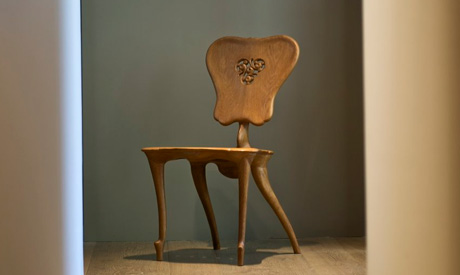
Butaca Casa Calvet

This elegant chair was designed by Gaudí for the dining room in Casa Batlló. It is one of the first items of furniture to be ergonomically adapted. Its design presents a reduction of the structure to the bare minimum and an adaptation of the shape to the human body, resulting in a high level of comfort. There is a notable lack of straight lines. The wings on the back make the chair easy to move around. The legs are seemingly straight, but in fact they have a slight curvature near the bottom.

Material: varnished solid oak
Measurements: 74 x 52 x 47 cm

Silla de costura Casa Batlló

Sewing Chair, designed by Gaudí for Mrs. Batlló. It adapts to the body posture. Its line eludes straight shapes.

Material: “Melis” pine tree wood
Dimensions: 93 x 28 x 44cm (36 x 11 x 17 in, approx.)

La Pedrera, Casa Milà is Antoni Gaudi’s work

Casa Milà, popularly known as La Pedrera (meaning “stone quarry” in Catalan), is Antoni Gaudí’s last civil work, which he started in 1906 and finished in 1912. Although Antoni Gaudí was particularly well known for his modernist phase, this work is considered “modern”. Included in the World Heritage List in 1984, along with Park Güell and Palau Güell, it was one of the first places of the industrial era to be added to the list of the most exceptional sites in the world. Its nickname, “La Pedrera”, refers to its external appearance, where stone has been used as a key material for the design of the façade and the balconies.

La Pedrera

How to get to La Pedrera

You can get there by public transport on metro Line 3 (Green) and Line 5 (Blue), getting off at the “Diagonal” stop. You can find Casa Milà in Provença, on the corner of Passeig de Gràcia.

When to visit La Pedrera

La Pedrera opens all year round, although its opening hours change depending on the time of year.
From 1 March to 3 November: 9:00 to 20:30
From 4 November to 28 February: 9:00 to 18:30

La Pedrera Casa Mila

10 interesting facts about La Pedrera

1. Did you know that Antoni Gaudí only designed 3 residential buildings? The first was Casa Calvet, then Casa Batlló and finally Casa Milà.

2. Antoni Gaudí did not finish La Pedrera as he would have liked, due to disagreements with the Milà family. Initially, he wanted to include a large sculpture of the Virgin Mary at the top of the building, an idea that did not prosper. In this respect, not only did he have differences with the family, but also with the local residents and Barcelona City Council.

3. Did you know that La Pedrera was ridiculed in its time? Mocking its modern style, it was compared to a garage for zeppelins, for example, in this cartoon published in the satirical newspaper L’Esquella de la Torratxa.

La Pedrera Roof

4. Casa Milà has one of the most iconic terraces in the city due to the sculptured chimneys and air vents that Antoni Gaudí designed for this emblematic building. In line with his usual style, Gaudí designed a terrace full of curves, with both decorative and functional purposes, enabling the better distribution of the light through its two enormous inner courtyards.

5. The Sagrada Familia can be seen from the terrace of La Pedrera. Just like the terrace of Casa Batlló, the architect designed a space from which to admire his most important work: the Sagrada Familia.

Casa Mila

6. Did you know that La Pedrera inspired George Lucas? Although it is not known for sure, there are people who say that the director and creator of Star Wars was inspired by the chimneys of La Pedrera for the design of the helmets of the imperial soldiers.

7. Antoni Gaudí, a pioneer of recycling. The architect reused waste glass and ceramic for decorative purposes, both on the chimneys and air vents and for the creation of the trencadís, a type of decoration with broken mosaic.

8. La Pedrera was the first house on Passeig de Gràcia with underground parking for carriages. This is one interesting fact about its construction. Another is that there is not a single load-bearing wall in the whole building, they are all columns and open spaces.

9. The stone used for the ground floor of La Pedrera was initially from the Garraf stone quarry, and later stone from Vilanova was used. Both towns are located 30 and 50 km away from Barcelona, respectively.

10. Current uses of La Pedrera. Currently, one part is still a residential building and the other has been turned into a cultural centre managed by the Fundación Catalunya La Pedrera. This centre has an office area and other visitor areas, such as the final floor apartment and the loft that accommodates the Gaudí Space, an exhibition area showing models of his most outstanding works.

Interior de la Pedrera

Casa Calvet furniture

Taburete Casa Calvet

This is a beautiful corner stool with smooth curving lines. It has a small backrest which resembles the central balconies on the rear facade of Casa Calvet. The legs, as well as their joining parts, are straight, creating an interesting contrast. It is characterised by its simplicity and comfort. This stool was devised by Gaudí to fit into one of the corners of the director’s office in Casa Calvet.

Material: varnished solid oak
Measurements: 58 x 65 x 41 cm.

Sillón Casa Calvet

The style of this piece is halfway between the furniture designed by Gaudí for Casa Calvet and the items that he later designed for Casa Batlló. The round seat, which is rather austere and free from ornamentation, is attached by a support to the distinctive heart-shaped back. From this same support, the two arms project, each ending in an arch-shaped hand. Gaudí designed this armchair for the director’s office in Casa Calvet.

Material: varnished solid oak
Measurements: 65 x 70 x 52 cm.

Banco Casa Calvet Flores

A great work of ornamental carving. The back is composed of three large flowers, which are in turn surrounded by a further three floral motifs. Worthy of note is the fact that the arm is joined to the back by a cantilever structure, which makes this item of furniture both very graceful and fragile, in spite of its considerable size. It is remarkable for the richness of its decoration. This beautiful two- or three-seater bench took pride of place in the meeting room at Casa Calvet.

Material: varnished solid oak
Measurements: 118 x 95 x 54 cm.

Silla Casa Calvet Flores

This chair was designed by Gaudí for the meeting room in Casa Calvet. It has a very richly decorated design with an elegant central motif on the chair back. Its trapezoid shape makes it especially graceful. Gaudí used geometrical patterns of interlaced circles and coffee beans. The seat has five aligned holes to prevent the person sitting on it from slipping. Of particular interest is the use of a single support to join the seat to the backrest.

Material: varnished solid oak
Measurements: 52 x 94 x 54 cm

Park Güell

Park Güell in Barcelona

Park Güell in Barcelona was designed by Antoni Gaudí between 1900 – 1914 at the request of Eusebi Güell. At the time, the patron-architect relationship was well established following several previous commissions, such as El Capricho, the Güell Estate and Palau Güell.


The original request was to create a housing development for families within an estate with over 17 hectares, popularly known as the Bare Mountain. This development had a series of extremely restrictive requirements such as, for example, the fact that building could only be carried out on a sixth of the estate. Furthermore, its location and height could not obstruct sunlight or prevent residents from seeing the sea views and the Barcelona esplanade.

It was given the name of Park Güell due to the influence of the British residential parks that Eusebi Güell so loved, and his request to recreate them.

Construction of the park was carried out during Gaudí’s naturalist stage, when he perfected his personal style, inspired by the organic forms of nature. One of his greatest works, Casa Batlló, is also an example of this stage.

Is Park Güell a must-visit in Barcelona?

This park is one of the icons of Barcelona, a city that has over 400 dragons in allusion to the legend of Saint George (the patron saint of Catalonia). Of all these dragons, Park Güell is the most photographed and world-renowned.

Until recently it was free to visit Park Güell. Now, due to the high influx of visitors, the City Council has decided to regulate access, establishing a limited capacity of visitors and an entrance fee. That is why we recommend that you buy your ticket in advance.
Despite this, Park Güell does have areas that are free to visit, especially in the surrounding areas where you can enjoy Gaudí’s architecture.
Visits to the city are unique and it is one of the most common photos that truly represents Gaudí’s Barcelona.


How to get to Park Güell

You can get there by metro on Line 3 (green line), getting off at the Lesseps or Vallcarca stops, where there is a 20-minute walk to the main entrance, which is on Carrer de Larrard.
You can also get there by bus on lines H6, D40, D24 and V19. The green route of the city’s Bus Turístic also stops at Park Güell.

Opening hours. When does Park Güell open? When does Park Güell close?

Although it is open all year round, it is important to check the opening hours of Park Güell, which change depending on the time of year.
Winter opening hours: From November to February the park is open from 10:00 to 18:00
Summer opening hours: From May to August, the park is open from 10:00 to 21:00
In March and October it opens from 10:00 to 19:00
In April and September it opens from 10:00 to 20:00

Remember: Take into account that last entry is always one hour before closing.

History of Park Güell

Do you want to know more about its history? We have already spoken of its origin, but there are some curious facts that you may not know about Park Güell. Here are a few:

Work started in October 1900. The first thing that was done was to level out the land for the subsequent construction of different properties. This first stage was concluded in 1903. The same year, the fence that encloses the site and the area reserved for horse-drawn carriages were also finished.

Antoni Gaudí designed several water collection and storage systems to irrigate the vegetation and avoid the erosion of the land, which could result from periods of heavy rainfall.

Antoni Gaudí moved to Park Güell in 1906, alongside his father and niece.


The famous Hypostyle Hall or Hall of a Hundred Columns was finished in 1907, inspired by the Greek town of Delphi, and it actually only has 86 columns.

With the outbreak of World War I in 1914, and after facing difficulties in the sale of the different properties, work was paralysed and abandoned entirely. At the time only 2 houses had been built, including that of Eusebi Güell, who moved to his dream park in 1907. The main difficulties surrounding the housing development were transport to the area and its exclusivity.
Although there were no residents, during these years Eusebi Güell did enable the celebration of festivals and civil events on the large square, which were generally welcomed by Eusebi and the rest of residents.

Eusebi died in 1918 and his heirs offered the park to Barcelona City Council, which agreed to the purchase in 1922. It was not opened as a municipal park until 1926 and it has since been the city’s most important and prominent park.

This much-loved park, which is greatly appreciated by the people of Barcelona, also gained appreciation the whole world over in 1984, when it was declared a UNESCO World Heritage Site.

Casa Calvet

In 1897 Gaudí was asked to construct a building for the heirs of the cotton industrialist Pere Màrtir Calvet. The family bought a site in Calle Casp in Barcelona, and it was there that Gaudí erected his most conservative work. In Casa Calvet, with its simple structure, Gaudí abandoned his former inspirations of Moorish and oriental approaches and surrendered himself to the influences of the baroque style.

Casa Calvet, which is remarkable for the originality of the volumes of its rear facade, the organic shapes of the furniture that Gaudí designed especially for it, and the luxury of its rooms, in particular the entrance hall and the staircase, was chosen by the Barcelona City Council to receive the best building award in the year 1900.

Palau Güell

Palau Güell

Palau Güell in Barcelona was Antoni Gaudí’s first commission from Eusebi Güell in 1885. It is a city mansion full of every conceivable kind of luxury and located in one of the most popular, and most run-down, districts of Barcelona at the time: the Raval district.

Interestingly, most of the families belonging to the Catalan bourgeoisie at the time preferred to establish their residence in the Eixample district. Ildefons Cerdà’s urban development plan proposed a new configuration of the urban space, with parks and gardens within blocks. Therefore, it is no surprise that the city’s wealthy families wanted to live in this new district.


Where is Palau Güell?

Today, Palau Güell is located on Nou de la Rambla, 3-5. Until 1979 this street was called Conde del Asalto and it was the first in Barcelona to be built with pavements, a drainage system and two lanes of traffic.

How to get there You can get there by Metro, getting off at the Liceu stop (Line 3) or by bus (Lines 14, 59, 91, 120 and Barcelona Bus Turístic).

Eusebi Güell paid 195,000 pesetas (€1,175) for a 589 square metre plot, which Gaudí made the very most of. In total, the building has 2,850 square metres over seven floors, and all rooms are based around the central hall.

Eusebi Güell’s mansion had a dual function: on one hand, to house his large family and, on the other, to host all of the events from his active social life. He therefore needed both public and private areas.

History of Palau Güell

Building began on Palau Güell in 1885 and it was finished in 1890. It is a surprising building, taking into account the contrast to his earlier work.

While its exterior is seemingly understated and almost devoid of decoration, it is a surprise to discover its lavish interior. Rooms are distributed around a central hall, which is rather like an internal courtyard and serves as a source of light.


In 1936, with the outbreak of the Civil War, the Mansion was seized and used as a police barracks with jails.

Façade of Palau Güell

Gaudí designed a simple, yet brilliant, façade, which stands out within the neighbourhood, located on a narrow street with limited views. Two years before Güell Palace was finished, Edén Concert music hall was opened opposite, dedicated to concerts and variety shows. Gaudí’s work, and specifically the façade that he designed, emerged as a way to counterbalance the extravagance of the music hall and of the district in general.

Despite the simplicity of Gaudí’s façade, the Catalan architect did not overlook the volumetric range of the stone and iron that he combined with the use of ceramics. Its symmetry, volumetry and padded appearance inevitably resemble the Florentine palaces of the Renaissance.

The façade, which is 22 metres high and 23.60 metres wide, has three horizontal levels:
– The lower level, with two large catenary arches.
– The middle level, dominated by the large gallery.
– The upper, simpler level, crowned by a balustrade.

The entryway to the building, one of the most original designed by Gaudí, features a wrought iron masterpiece on the gates of the two catenary arches. The two entrance doors are 4.9 metres high and stand out due to the way they are adorned, with vegetable, animal and symbolic elements that are at their finest on the spandrels, which hold the initials of the developer, Eusebi Güell.

On the lower part, the master forger Joan Oñós created a lattice that enabled residents to observe what was happening on the street without being seen, respecting their privacy. Between these two entrance arches the gatehouse is located, a small window crowned by a 3.50 metre high crest that represents the senyera, the four-striped Catalan flag that, in this case, are depicted with flat iron and metallic netting.

A helmet crowns this representation of the senyera, in allusion to strength, one of the four cardinal virtues. At the very top stands a Phoenix, a mythical animal that is an emblem of the economic and cultural renaissance experienced by Catalan society.

Finca Güell

This estate was Gaudí‘s first work for the man who became his patron and his friend, and it marked the beginning of an intense and productive professional relationship.
Güell owned several estates in Barcelona, in the district known today as Zona Universitaria, and he commissioned Gaudí to design the boundary wall and the gates giving access to this property. He also subsequently asked the architect to build the stables and various other small buildings. In these, Gaudí used, for the first time, cut pieces of tiles in the form of a mosaic, in a style which has become universally known as trencadís, from the Catalan word trencar, meaning “to break” in English.

The most important part of this work as a whole is its iron gate: it is a great triumph of craft, in which Gaudí combined all of the different techniques he knew for forging iron.
Nowadays, the best surviving vestige of this estate is its dragon. Gaudí recreated the legend of Ladon, the dragon which guarded the entrance to the Garden of the Hesperides, in tribute to the Catalan poet Verdaguer and his epic poem “L´Atlàntida”.

El Capricho

This house belonging to Máximo Díaz de Quijano, brother-in-law of the Marquis of Comillas, was designed by Gaudí in the town of Comillas, in the historical region of Cantabria. One of his youthful projects, Gaudí was 31 years old when he built it, and it does not yet display many of the construction techniques which would characterise his later work.

It was given the name “El Capricho” in reference to, and drawing an analogy with, the free and capricious style of the musical work by the same name.

The structure is simple and traditional, with a U-shaped ground plan and a graceful tower not unlike a Persian minaret. What sets it apart is its facade, which is bursting with energy and colour.

This is a work of great originality and fantasy, in which Moorish influences are very much in evidence, for example in the intense combination of materials such as brickwork, tiles, wrought iron, etc.

Sunflowers provide the main decorative motif.

Casa Vicens

Gaudí was given this commission in the year that he graduated, 1878. He was 26 years old when he was faced with his first major project.

Casa Vicens, located in what was then the town of Gràcia, was intended as the second home of Manuel Vicens Montaner. Gràcia, which was separate from Barcelona but adjacent to it, was a very popular spot with many of the middle-class families of the day.

The structure stands out for its simplicity, its colouring, its natural motifs, its abundant decoration, and above all for its boldness.

The building includes features which are precursors to modernism, in that it displays a combination of traditional materials and decorative arts as well as being strongly reminiscent of Moorish and oriental architecture.

The characteristic features of the house are its ornamentation, and above all its marigolds.

Sagrada Familia

History of the Sagrada Familia

The expiatory temple of the Sagrada Familia, the construction of which commenced in 1882, is today one of the emblems of Barcelona, known around the world and visited by millions of people. The part built by Gaudí was declared a UNESCO World Heritage Site in 2005. The Construction Board hopes to finish the works in 2026, marking the centenary of Gaudí’s death.

In 1881, thanks to donations, the Spiritual Association of the Devotees of Saint Joseph bought a 12,800 m2 plot to build the temple. But the first stone was not placed until 19 March 1882, on Saint Joseph’s day. Initially, the project was commissioned to another architect, Francesc de Paula Villar, but Gaudí assumed the position at the end of 1883. His new project was much more ambitious than that proposed by his predecessor. It included the construction of a temple with 5 naves, a transept, an apse, an exterior ambulatory, 3 façades and 18 towers. It was the most complex and unique project that Gaudí had carried out throughout his professional career, to which he dedicated 43 years of his life.

Did you know that initially Gaudí only completed building on the Nativity façade with its 4 towers because he knew that he would never see it finished?

The work of Antoni Gaudí, who wanted to create the perfect temple, presents the life of Jesus and the history of faith. The 18 towers are dedicated to important biblical figures, and this is reflected in their size: 12 of them represent the apostles, 4 the evangelists, one the Virgin Mary and the highest of them all represents Jesus Christ, which will be topped by a cross reaching a height of 172 metres. When it has been completed, the Sagrada Familia will be the highest building in Barcelona and the highest church in the world.

La Sagrada Familia

From 1914, Antoni Gaudí ceased his work on civil projects and focused solely and exclusively on the construction of the temple. On 30 November 1925, construction of the first bell tower of the Nativity façade was completed. This is the only one that Gaudí would see, as on 10 June 1926 he died as the result of a tragic accident that occurred three days earlier, when he was run over by a tram. The Nativity façade was finally finished in 1930.

Did you know that the Sagrada Familia had schools for the children of those working on the temple?

Following Gaudí’s death, his disciple Domènec Sugrañes took over construction until 1938. Despite his willingness, during the Spanish Civil War there was a fire in the crypt, which also affected the provisional schools and the workshop where Antoni Gaudí had left all of the plans and models for others to conclude his work. This information was not entirely recovered, so we will never fully see what the architect had envisaged.

Did you know that it took 22 years to build the Passion façade, the temple’s second façade? Construction started in 1954 and it was finished in 1976. They tried to build it as close as possible to what Gaudí had in mind.


Interior de la Sagrada Familia

Architects and evolution of the works

Since his death, several architects have inherited Gaudí’s legacy. Besides Domènec Sugrañes, work has also been undertaken by Isidre Puig BoadaLluís Bonet i GaríFrancesc de Paula Cardoner BlanchJordi Bonet Armengol and Jordi Faulí Oller, who has held the position since 2012.

Did you know that the Sagrada Familia will be the highest building in Barcelona and the highest church in the world with a height of 172 metres?

Like all expiatory temples, sources of revenue for the Sagrada Familia can only come from donations and personal contributions. Thanks to this income and to technological advances in construction, it is possible for the work to be finished within the established term. Since the year 2000, vaults have been completed structurally and closed, the foundations of the Glory façade have been laid, the Passion façade has been completed, with the participation of Josep Maria Subirachs, and the Japanese sculptor, Etsuro Sotoo, is completing the decoration on the façade.

On 7 November 2010, Pope Benedict XVI visited the temple, declaring it a Basilica and officiating a solemn mass.

As already mentioned above, it is planned to finalise the construction by 2026, marking the centenary of Antoni Gaudí’s death. A moment that will be emotional for Catalans and devotees alike. It will have an even greater significance if Gaudí is declared as the Saint of the Catholic Church, a proposal launched in 2000 by the Association for the Beatification of Antoni Gaudí.

Luz interior de la Sagrada Familia

Why visit the Sagrada Familia

The Expiatory Temple of the Sagrada Familia is the final construction in Gaudí’s career, a unique place in Barcelona that will become the highest Basilica in the world once work has been completed. A Gaudí masterpiece that has been under construction for over one century.

Among many other wonders of this work is the spectacular play of light and colours that can be appreciated inside the temple when rays of sunlight enter through the stained glass, a world of sensations that changes depending on the time of day.

Did you know that the Sagrada Familia can be seen from Casa Batlló and La Pedrera?

It is also possible to visit the towers of the Sagrada Familia to enjoy unique views of the city. Many people ask which is the best tower to visit. In actual fact, one is not any better than the other, but there are differences. In the case of the Tower of the Nativity façade, dating back to Gaudí’s time, there is no lift to the very top, but it is possible to climb a narrow spiral staircase, which is not suitable for all visitors.

For visitors who are not in a good physical condition or for those who have a phobia related to small spaces, it is better to visit the Passion Tower. Either way, no visit to the Sagrada Familia is complete without visiting the towers, a hugely important element in Gaudí’s work, as it was the closest you could get to heaven.

Columnas de la Sagrada Familia

How to get to the Sagrada Familia

C/ de la Marina N 41º 24´ 283´´ | E 2º 10´486´´
Metro L2 and L5 Sagrada Familia. / Bus 19, 33, 34, 43, 44, 50, 51, B20 and B24.
General entrance: general entrance at the Nativity façade, on c/ de la Marina.

Opening hours of the Sagrada Familia:

From November to February: from 9:00 to 18:00.
March and October: from 9:00 to 19:00.
From April to September: from 9:00 to 20:00.
25 and 26 December and 1 and 6 January: from 9:00 to 14:00.

Streetlights for Plaza Real and Pla de Palau

During his studies, Gaudí worked with Josep Fontserè i Mestre as a draughtsman for the entrance gate to the Ciutadella Park. Upon finishing this project, the Barcelona City Council commissioned him to design the public lighting of two of the city’s squares: Plaza Real and Pla de Palau.

The young Gaudí, who had recently graduated as an architect, created two different designs, one with six arms and another with three, both with gas lamps with a stone base and a wrought iron and bronze column.

The two lampposts that are located on Plaza Real have six arms and are characterised by their colourful details from the stone base, where Gaudí included a large iron medallion with floral motifs. The cast iron column emerges from the base, the bottom of which boasts subtle plant motifs with ivy leaves. He placed the Barcelona coat of arms in the middle of the column and small red floral motifs above this, just below the six arms that hold the glass lanterns. Without a doubt, the most original part is the top of the lamppost, which is crowned by a Caduceus with two snakes and a winged helmet, symbols that represent Mercury, the Roman god of commerce, an activity with which Barcelona, a highly commercial city, identified at the time, thanks to the port located near to the square.

The project submitted by Gaudí to the City Council bears witness to the simplicity of these lampposts. The project also justified the selection of all of the materials used for their creation:

“Creating a candelabra of noble simplicity, without weakness, giving each part the importance it requires, and strictly complying with the requirements for which it has been created: the greatest frankness has been followed with due formality in the use of the materials, leaving their structure and layout completely visible, not accepting, by any means, that a layer of colour may attempt to create the illusion of materials and objects that do not exist and which the weather would continually cause to disappear, showing the real material, like the nudity of the beggar, seen between the rags”.

gaudi_plaça_reial_barcelona_general

Despite being one of Gaudí’s first projects, his self-assurance is already apparent, judging by the reference made to payment in the executive project. Gaudí did not propose a fixed payment or lump sum for the project, as was common at the time, but rather the total price after installing the lampposts. Thus, Gaudí was clearly convinced that he would spend less than the proposed quote: three thousand six hundred and five pesetas, including a contingency budget.

In 1890, a decade after creating the lampposts in Plaza Real, he was commissioned to design those located on Pla de Palau in the same city, which stand in front of the Government Building. The design is the same as those located on Plaza Real, except for the fact that they have three arms and are not as abundantly decorated. At the top of the lampposts is an inverted crown, supported by three dragons, with protruding heads.

farolas-pla-del-palau-barcelona

Ver más obras de Gaudí